
What We Put on the Desks Before a Team Workshop Begins
Tom Ellison
7 min read
A look at the kit, room layout and running order we rely on for classroom workshop days in Shrewsbury, and why each choice helps newsroom teams and student cohorts learn faster.
Starting with the room, not the camera
Most of what makes a team workshop work is decided before anyone arrives. In our Shrewsbury classroom we arrange tables in clusters of three or four, so each small group has its own camera, tripod and monitor within arm's reach. Nobody has to queue for equipment, and nobody sits at the back watching someone else's hands.
I coordinate these days, so the room is my responsibility. I walk through it the afternoon before with a printed floor plan: where the cables run, where the daylight falls, which wall is clear enough to act as a plain interview backdrop. A tidy room tells a group that the day has been thought through, and that sets the tone for people who may be nervous about being filmed.
We also keep one corner free of equipment altogether. It holds chairs, a flip chart and the kettle, and it is where a group can step away to talk through a problem without a lens pointed at them.
The tutor leading the day can then spend their energy on teaching rather than on fixing the room.
- Tables in small clusters, one camera set per cluster
- A clear wall for interview backdrops
- A quiet corner away from the equipment
- Cable routes planned and taped down in advance
The kit we choose and why it is deliberately modest
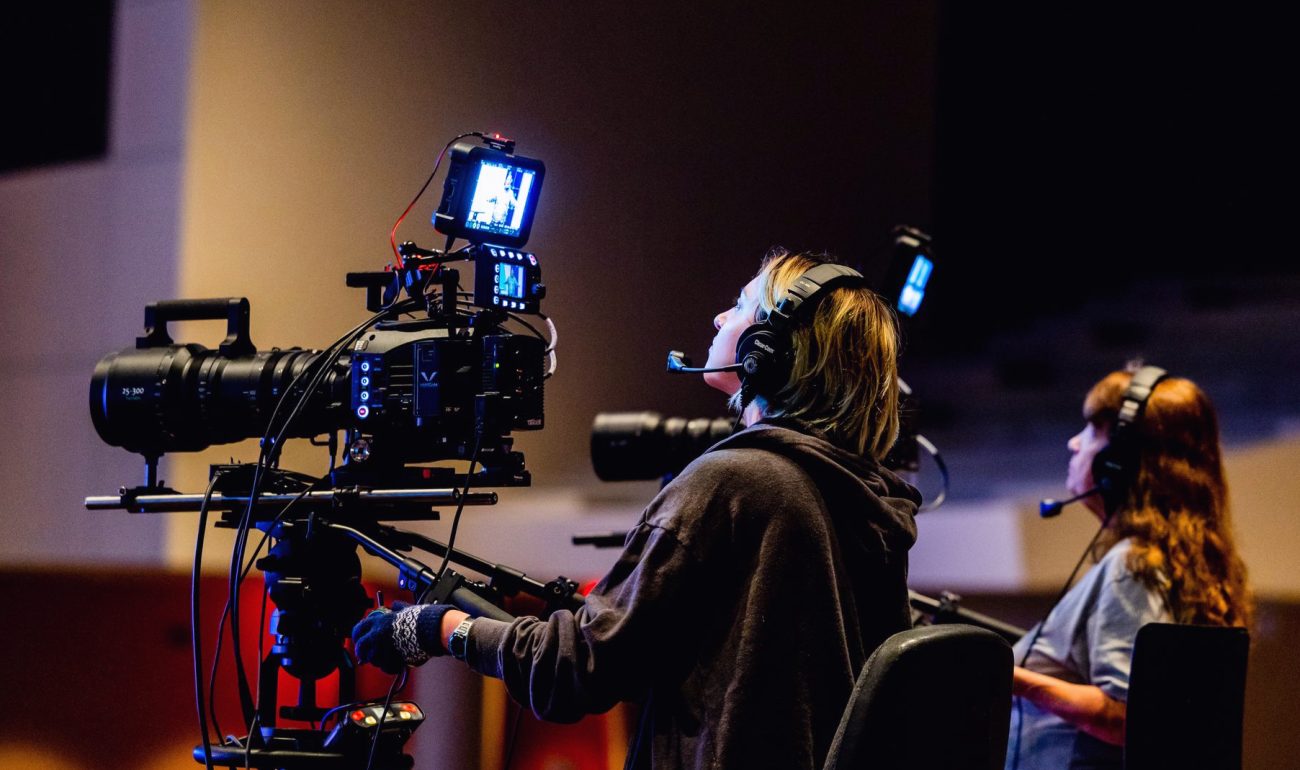
The cameras on our desks are ordinary broadcast-style field cameras, the type a regional newsroom would send out on a typical job. We avoid exotic gear on purpose. A team that learns on equipment far beyond what they use at work goes home with habits that do not travel.
Each set comes with a tripod, a handheld microphone, a clip-on microphone and a small portable light. That covers the shots most reporting days demand: a standup, a two-way interview and a cutaway. Keeping the kit list short means every learner meets every item and handles it properly.
Spare batteries and memory cards are labelled and numbered. It sounds like a small thing, yet fumbling for a card that turns out to be full is exactly the kind of mishap we want people to meet in the classroom rather than at a live location.
Before the first exercise, each group checks its own set against a printed list and signs it off themselves.
- Field camera and tripod per group
- Handheld and clip-on microphones
- One small portable light each
- Numbered cards and batteries, checked at the start
Tailoring a day to the group in front of us
A group of working newsroom colleagues needs a different day from a student cohort, and we plan accordingly. Before booking is confirmed I ask a handful of plain questions: who is coming, what they shoot week to week, and which problems keep recurring. The answers shape the running order.
A newsroom team often wants to tighten handheld stability and interview framing, because those are the faults their editors see most. A student cohort usually benefits from starting with the basics of exposure and focus, then moving on to delivery. The tutors then pick from our training topics to fit.
We do not use a fixed slide deck. Tutors keep a bank of exercises and select from it, so the order of the day can shift if the group is stronger at one skill than expected. That flexibility is the whole point of a tailored day.
Where a team has particular footage they struggle with, they are welcome to bring a short clip and we will work from it during the session.
- A short planning conversation before the day
- Exercises chosen from a bank, not a fixed deck
- Space for the group's own clips and problems
How the hours are shaped
We keep a rhythm that alternates short explanation with practical work. A tutor demonstrates something for ten or fifteen minutes, then the groups try it themselves while the tutor moves between tables. Long lectures lose a room quickly, and with cameras sitting idle on the desks the temptation to fiddle is strong.
Mid-morning we usually shoot something simple and short, such as a thirty-second piece to camera or a two-person exchange. After a break the group watches the results together on a large screen. That playback is where most of the learning lands, because people see their own framing, voice and posture without anyone having to describe it.
The afternoon builds on the morning. Groups repeat an exercise with one thing changed, perhaps the position of the light or the length of the question, and compare the two takes side by side.
We finish with a short written summary of points for each person to take back to their own work.
- Short demonstrations, longer practice
- Group playback on a large screen
- Repeat exercises with one variable changed
Feedback that people can actually use
Feedback in a group setting can go wrong in two ways: it is either so gentle that nothing changes, or so blunt that people stop trying. We aim for something in between, and we set the ground rules at the start of the day. Comments describe what is on the screen, not the person who made it.
Tutors point to one or two things per take rather than a long list. A reporter who hears six corrections at once keeps none of them. We ask each person to name their own priority before the tutor adds anything, and it is often the same one the tutor had in mind.
We also encourage colleagues to comment on each other's footage, with a tutor steering. Newsroom teams in particular find this valuable, since they will be giving one another notes back at work and the day gives them a shared, calm way to do it.
Written notes go home with each learner, short enough to read on a train.
- Comments describe the footage, not the person
- One or two points per take
- Peer comments, steered by the tutor
What we keep adjusting between groups
No two workshop days run quite the same, and after each one I sit down with the tutors to note what worked and what dragged. A light stand placed awkwardly, an exercise that ran too long, a table that was too close to the window: all of it goes on a running list that feeds the next room plan.
Over the years this has changed how we work in small ways. We now allow more time for the first set-up, because teams that rush it carry the confusion through the day. We have shortened the opening introductions, since people would rather pick up a camera than hear about the building.
If your team is considering a day with us, the most useful thing you can send is a plain description of how you work and what you would like to be different afterwards. From that we can choose the kit, the layout and the pace that suit you.
A good workshop day is built from plain choices: a room set out so everyone can reach the equipment, kit that matches what people use at work, a running order that fits the group, and feedback people can act on. None of it is complicated, but all of it is planned. If you are weighing up a team day in Shrewsbury, get in touch through the contact page and tell us how your group works.
Ask for a quote
Write to us: hello@elupho.com